


Intestacy Rules In England & Wales
05/08/26
What Happens If You Die Without a Will?
Here's an uncomfortable statistic: only around 35–40% of UK adults have actually made a Will. That means the majority of us are relying, whether we realise it or not, on a set of rigid legal rules to decide what happens to everything we own when we die.
Those rules are called the rules of intestacy, and they don't care about your relationships, your wishes, or who actually needs the money. They follow a fixed formula. If you've never read them, some of the outcomes might genuinely surprise you.
This guide walks through how it all works in plain English — including the one figure that trips almost everyone up: the Statutory Legacy.
What Does "Intestacy" Actually Mean?
"Intestate" simply means you died without a valid Will in place. This can happen for a few reasons:
- You never got around to writing one
- You wrote a Will, but it wasn't signed or witnessed correctly, so it's not legally valid
- Your Will is out of date — for example, marriage automatically cancels a previous Will
- Your Will only covers some of your estate, leaving the rest to be dealt with by intestacy rules (this is called "partial intestacy")
In any of these situations, the law steps in and makes the decisions for you.
Who Decides Who Inherits?
In England and Wales, intestacy is governed by the Administration of Estates Act 1925, updated over the years by later legislation. You don't need to know the legal history — just know that it sets out a strict "order of priority" for who inherits, and how much. It's a one-size-fits-all formula, applied the same way whether your family situation is simple or complicated.
The Big Myth: "Common Law Marriage"
Let's clear up the most common and most painful misunderstanding first.
There is no such thing as "common law marriage" in England and Wales. It doesn't matter if you've lived with your partner for 2 years or 20 — if you're not legally married or in a registered civil partnership, you have no automatic right to inherit anything if they die intestate. Not their savings, not their share of the house, nothing.
This surprises a huge number of people, and it's one of the strongest arguments for writing a Will if you're in a long-term unmarried relationship.
If You're Married or in a Civil Partnership: What Your Spouse Gets
If you die intestate and you have a spouse or civil partner, there are two very different outcomes depending on whether you also have children.
No children: Your spouse or civil partner inherits your entire estate. Simple as that.
Spouse or civil partner and children: This is where things get more complicated — and where the Statutory Legacy comes in.
What Is the Statutory Legacy?
The Statutory Legacy is a fixed sum of money that a surviving spouse or civil partner is automatically entitled to, taken off the top of the estate, before anything is divided up with children. It exists to protect the surviving spouse from being left with very little if the estate has to be shared.
As of 2026, the Statutory Legacy is £322,000. This figure was set in July 2023 (up from £270,000) and is reviewed periodically in line with inflation, so it's worth double-checking the current amount if you're reading this some years from now.
Here's how it plays out step by step when there's a spouse and children:
- The surviving spouse or civil partner keeps all personal belongings ("chattels") — furniture, jewellery, the car, and so on.
- They then receive the Statutory Legacy (currently £322,000) from the estate.
- Whatever is left over ("the residue") is split — half goes to the spouse, and half is divided equally among the children.
A worked example:
Imagine someone dies leaving an estate worth £500,000, a spouse, and two children.
- The spouse takes personal belongings.
- The spouse takes the first £322,000 as the Statutory Legacy.
- That leaves £178,000 as residue.
- The spouse takes half of that (£89,000), bringing their total to £411,000.
- The remaining £89,000 is split between the two children — £44,500 each.
If instead the whole estate had been worth £300,000 — less than the Statutory Legacy — the spouse would simply take the entire estate, and the children would inherit nothing at all.
No Spouse? Who Inherits Then
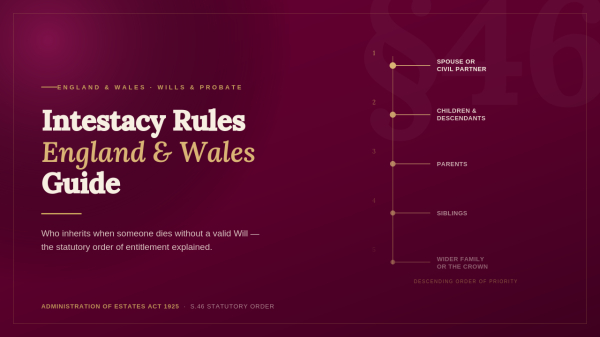
If there's no surviving spouse or civil partner, the estate passes down a fixed order of priority:
- Children (divided equally between them)
- Parents
- Siblings (full-blood siblings first)
- Half-siblings
- Grandparents
- Aunts and uncles
Each category only inherits if there's no one alive in the category above it. And if a child has already died before the parent, that child's own children (the grandchildren) usually step into their place and inherit their share instead — this is sometimes called "per stirpes" distribution- meaning ‘through the root’.
If there's genuinely no one left in any of these categories, the estate passes to the Crown, Duchy of Lancaster or Duchy of Cornwall — known as bona vacantia (meaning 'vacant goods' or 'ownerless property').
What About Stepchildren, Unmarried Partners, and Friends?
Under the intestacy rules, the following people inherit nothing automatically, no matter how close the relationship:
- Unmarried, cohabiting partners
- Ex-spouses (only once ‘final order’ is granted - formally known as the ‘decree absolute’)
- Stepchildren who were never legally adopted
- Foster children
- Fiancé(e)s, even if a wedding was already planned
- Friends, however close
If you've been left out and you think you have a genuine claim — for example, you were financially dependent on the person who died — it may be possible to bring a claim under the Inheritance (Provision for Family and Dependants) Act 1975. But this involves going to court, and it's typically expensive, uncertain, and emotionally draining, often settling for less than a Will would simply have guaranteed.
Why This Actually Matters
These aren't just abstract legal technicalities — they have real consequences:
- Blended families can end up in conflict, with children from a previous relationship legally entitled to a share of money or property that a surviving partner is relying on to live.
- Unmarried couples can lose the family home entirely if it was in the deceased partner's name, with no automatic right to stay, especially if there are no children
- Families already dealing with grief are forced to navigate a rigid legal process at the worst possible time, sometimes with outcomes nobody would have chosen.
The Simple Fix: Write a Will
The good news is that all of this is entirely avoidable. A valid Will lets you decide, in your own words:
- Who inherits what — including unmarried partners, stepchildren, friends, or charities
- Who looks after your children if they're under 18
- Who administers your estate (your executor)
- How to minimise unnecessary stress and cost for the people you leave behind
Writing a Will doesn't have to be complicated or expensive, especially for straightforward estates — but if your situation involves property, a business, or a blended family, it's worth speaking to a solicitor or a qualified Will-writer to get it right.
Quick Reference: Who Gets What Under Intestacy
|
Situation |
Who Inherits |
|
Spouse/civil partner, no children |
Spouse takes everything |
|
Spouse/civil partner + children, estate under £322,000 |
Spouse takes everything |
|
Spouse/civil partner + children, estate over £322,000 |
Spouse takes chattels + £322,000 + half the remainder; children share the other half equally |
|
No spouse, but children |
Children inherit everything, divided equally |
|
No spouse or children |
Parents, then siblings, then half-siblings, then grandparents, then aunts/uncles, in that order |
|
Unmarried partner |
Inherits nothing automatically |
The bottom line: if you'd rather these decisions reflect your own wishes than a 100-year-old legal formula, the only way to guarantee that is to make a Will.